Showing posts with label QE infinity. Show all posts

Friday, 17 April 2020

联储局资产负债表·扩至28兆创纪录

2020-04-17 17:07:00


(华盛顿17日讯)联储局的资产负债表规模本周增至创纪录的6.42兆美元(约28兆令吉),因冠病疫情严重打击经济之际,联储局动用几乎无限量的购买力来吸纳资产,令市场维持顺利运行。
自3月初以来,联储局将利率降至零、重启购债并推出前所未有的一系列举措,以维持信贷流动,并提振企业和家庭信心。
截至周三,联储局资产负债表较前一周的6.13兆美元增加近3000亿美元。3月第一周时才4.29兆美元。
如今联储局资产负债表规模相当于危机重创前的美国经济规模的30%左右,而且随着联储局继续买进资产以及经济萎缩,未来几周其占比肯定会越来越大。
据周四公布的数据,联储局继续吸纳美国公债、抵押贷款债券和其他资产。联储局所持抵押贷款支持证券规模由1.46兆美元升至1.57兆。公债持仓由3.63兆美元升至3.79兆。
联储局流动性互换使用规模从前周的3581亿美元升至周三的3783亿美元。
联储局贴现窗口贷款余额从一周前的434.5亿美元降至363亿美元。
通过联储局初级市场交易商信贷便利工具进行的贷款规模由前一周的330亿美元小升至334亿美元。货币市场基金流动性便利的使用规模由前一周的532亿美元降至507亿美元。
周四的报告首次显示了动用联储局最新支持工具。截至4月15日,商业票据融资便利II LLC持仓为9.74亿美元。该便利周二开始运作,这是联储局用美国财政部的种子资金设立的一种特殊目的工具。

文章来源 : 星洲日报 2020-04-17

Friday, 10 April 2020

联储局加码9.9兆救市·鲍威尔:强力复苏美经济

2020-04-10 16:52:00


(华盛顿10日讯)联储局公布了一系列计划,称这些计划将提供2.3兆美元(约9.9兆令吉)贷款,扩大联储局市场操作的适用范围,以援助中小企业及地方政府,并将买进垃圾债。
联储局还表示,将扩大之前宣布的企业贷款计划的适用范围,把之前排除在外的一些风险较高的债务类别纳入其中,包括允许评级直到最近还曾是投资级的企业参与这些贷款安排。
上述计划的推出意味着,联储局的角色已远超出其在2008年为防止金融恐慌加深经济低迷所起到的最后贷款人功能,这些计划依靠的是美国国会在最近通过的2兆美元经济救助立法中提供的数千亿美元的美国财政部资金。
暗示续宽松弹药支持经济
联储局主席鲍威尔稍后在记者会上表示,将动用所有权力“强力、主动且进取地”地帮助美国经济复苏,暗示将继续以宽松弹药支持经济。
鲍威尔说,联储局正在推行、仰赖紧急放款权力以支持信用流动的许多计划,都只会在非常时期才会推出,“我们将持续强力、主动且进取地动用这些权力,直到我们有信心认为(经济)正稳步地踏上复苏之路”。
他说,联储局的紧急工具将只有在“民间市场与机构能再度发挥关键功能”时,才会退场。他也乐观看待经济复苏展望,预料现行的管制措施一旦解除后便能实现,“一旦疫情获控制,企业重新开张,人们重回工作岗位时,我们有所理由相信经济反弹一旦鸣枪,将能够非常热络”。
鲍威尔也对政府部门喊话,表示“对受疫情打击最重者,提供直接的财务支援这项关键性任务,将落在民选官员们身上”。他强调,联储局的行动是源自于“放款权力,而非支出权力;联储局无权送钱给特定的受益者”,暗示联储局只有借钱、没有发钱的权力。
资产负债表扩至26.4兆
联储局的资产负债表规模本周增至创纪录的6.13兆美元(约26.4兆令吉),因其动用几乎无限量的购买力来吸纳资产,令市场维持顺利运行,尽管控制疫情的措施严重打击了就业和经济产出。
自从联储局四周前将利率降至零、重启购债并推出前所未有的限制疫情经济冲击的举措以来,联储局的资产负债表扩大了约1.7兆美元。债券持仓首次超过5兆美元。
整体而言,目前联储资产负债表规模相当于疫情危机前美国经济规模的四分之一以上,并且未来几周肯定将扩大,因联储局继续吸收资产且经济萎缩。
周四公布的数据显示,联储局继续买入公债、抵押债券和其他资产。联储局持有的抵押支持证券基本持平,约为1.46兆美元。公债持仓从3.34兆美元增至3.63兆美元。

文章来源 : 星洲日报 2020-04-10

Sunday, 29 March 2020

Why the Fed went nuclear with QE Infinity?

It took eight days for the Federal Reserve to go from QE of $US700 billion ($1.19 trillion) to unlimited buying of bonds to stave off an economic and financial crisis on 23 March 2020.

Forget the bazooka. The Federal Reserve has gone nuclear.
The embrace of QE Infinity by the world's most powerful central bank is a defining moment not only in this crisis but the history of central banking; a testament to the severity of the collapse in activity reverberating through the global economy and the financial system that sustains it.
With political incompetence writ large by the failure of the US Congress to approve a $US1 trillion-plus stimulus plan, Fed chairman Jerome Powell has stepped into the breach by signalling he will literally throw everything he can at efforts to buffer the free fall in the world's largest economy and prevent a global credit crunch.
But the historic commitment to unlimited quantitative easing – or purchases of government bonds and mortgage-backed securities – means the Fed has tacitly acknowledged that its efforts so far have not been enough. Far from it.
That the Fed went from unveiling $US700 billion ($1.19 trillion) in QE after an emergency Sunday meeting on March 15 to eight days later unveiling unlimited purchases to quell volatility in a malfunctioning US Treasuries market underscores the pace of a crisis that policymakers are struggling to catch up with and contain.

Reflect on these numbers. Of the $US500 billion in Treasury purchases announced on March 15, the Fed had spent $US272 billion by last Friday. Of the $US200 billion pledged in mortgage-backed securities purchases, it had bought $US68 billion.
At the rate of cash burn, QE Infinity seems like the only logical choice.
If the wisdom of the crowds is any measure, then Wall Street's 3 per cent overnight decline that brought the S&P 500 Index's fall from its peak to 34 per cent graphically illustrates the depth of worry about policymakers' ability to soften the blow from a crisis that looms as far more severe than the GFC.
Image


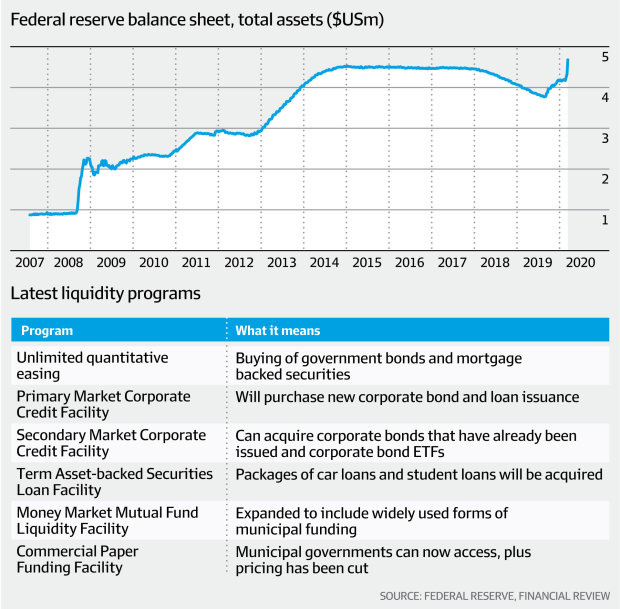
The growing number of funding facilities being launched by the Federal Reserve highlights the proliferation of stress points.

While the Fed is to be commended for understanding the clear and present danger, the need for these facilities highlights the accumulation of risk in the US economy – and the global financial system – from a complacency about benign economic conditions and easy access to cheap money.
Lessons learnt from the GFC? Zero.
The Term Asset-Backed Securities Facility is back after starring in the GFC, as the Fed seeks to keep the flow of credit running to businesses and consumers by buying debt like student loans and car loans.
Large employers also get to make their claim on the world's biggest balance sheet through the Primary Market Corporate Credit Facility and the Secondary Market Corporate Credit Facility.
Arguably the smartest move is the helping hand given to state and local governments through the establishment of a number of funding programs.
Why is this important? Because state government expenditures made up more than 40 per cent of government spending in 2019, which in turn accounted for more than a third of GDP.
State and local governments are also at the front line of the fight against the coronavirus and will need additional funds.

Infinity has its limits

The embrace of QE Infinity is clearly a groundbreaking move. But is QE Infinity limitless in reality? No quite.
Analysis done last week by Bank of America Securities shows the Fed could spend up to $US8 trillion.
The bank says the Fed holds 15 per cent of marketable US debt excluding bills, noting that it holds a large portion of debt with maturities of between 15 years and 22 years.
Noting the Fed's 70 per cent limit on holding each issue leads Bank of America to conclude $US8 trillion is the potential upside number.
However, the Fed is limited to $US1.5 trillion in US Treasuries with a maturity of 15 years or more.
At this point, the Fed has committed to not buy government debt in the primary market.
That means it won't buy debt freshly issued by the US Treasury, of which there is a likely tsunami coming given the big ticket stimulus set to flow through the economy once Congress gets its act together for the sake of avoiding an economic catastrophe.
But until that stimulus gets approved, the Fed is set to shoulder the responsibility to support the faltering US economy and a highly stressed financial system by itself.
But the reality is that unconventional monetary policy can't do it alone. The Fed can do a lot but it legally can't put money directly into the pockets of Main Street.
Source: Financial Review 24 March 2020
Robert writes on companies and markets. He is a former New York and Shanghai correspondent, and has worked in Hong Kong. Email Robert at robertguy@afr.com.au

Fed launches ‘QE infinity’

 24 March 2020

It’s to infinity and beyond as the US Federal Reserve announces unlimited asset purchases to support markets roiled by coronavirus panic and an oil price war.

The Fed had already committed to purchasing $500 billion of Treasury securities and $200 billion of mortgage-backed securities, but imposed no limits on the swathe of new measures it announced on 23 March. 
“The Federal Reserve will continue to purchase Treasury securities and agency mortgage-backed securities in the amounts needed to support smooth market functioning and effective transmission of monetary policy to broader financial conditions,” the Fed said in a statement. 
That effectively means that the Fed is willing to engage in large-scale asset purchases for as long as it takes to set markets straight. It will also significantly expand the range of that program to include corporate bonds issued by “investment grade US companies and US-listed exchange-traded funds whose investment objective is to provide broad exposure to the market for US investment grade corporate bonds.”
The Fed’s previous actions – including the multitrillion-dollar expansion of its overnight repo program – have done little to calm markets amidst uncertainty over the coronavirus outbreak.
“The Fed has thrown another lifeline to markets and the economy as the COVID-related disruption continues to ripple through the system,” said Anna Stupnytska, global head of macro at Fidelity International. 
“As its earlier interventions failed to abate severe stresses that have emerged in both US Treasury and mortgage-backed security (MBS) markets, the Fed has now pulled out the ultimate card – QE infinity – committing to unlimited purchases of government bonds and MBS. In addition, a number of new lending facilities have been unveiled, aimed at supporting the US corporate sector and households. This includes an unprecedented step to buy corporate debt – something other major central banks have done since the last crisis, but the Fed had so far managed to avoid.”
Further measures include the reopening of the Term Asset-Backed Securities Loan Facility (TALF), which will enable the issuance of asset-backed securities backed by student, auto, and credit card loans, as well as loans guaranteed by the Small Business Administration (SBA). 
“The coronavirus pandemic is causing tremendous hardship across the United States and around the world,” the Fed said. 
“While great uncertainty remains, it has become clear that our economy will face severe disruptions. Aggressive efforts must be taken across the public and private sectors to limit the losses to jobs and incomes and to promote a swift recovery once the disruptions abate.”