国家银行下午宣布将隔夜政策利率(OPR)调高25个基点,至2.50%,但没有对马股掀起太大涟漪。富时综合指数周四闭市报1494.73点,上升3.38点或0.23%。

美元是国际储备金的货币之一。 美元走强到2000年4月的新高。但是,全世界其他货币都在跌。 马币也跌到1USD=RM4.50。
1997年,金融风暴席卷亚洲,马币6个月暴跌46%,7月1日达到4.885的历史低位。
为应对马币贬值,1998年9月1日,马来西亚政府宣布将马币与美元挂钩,把两者之间的汇率固定在1美元兑3.8马币的水平,直至2005年7月21日开始放开管制并允许马币汇率浮动。


以下石油的介绍,来自知乎。
世界上目前有三种主要的石油基准价,Brent,WTI 和Dubai or Oman
分别代表着三个全球最大的石油出口地区及他们所覆盖的市场,Brent代表产自北海的石油(包括Brent, Forties, Oseberg and Ekofisk四个海域),且原油质量较高,重度轻且含硫少,适合提取汽油、柴油、以及其他高要求的石油制品。且由于是在海上开采,方便海路运输,其价格一直具有优势。Brent是全球最主要的石油基准价系统,三分之二的原油期货合约依据Brent定价。
WTI是west Texas Intermedia 的缩写,即产自美国的石油,其质量比Brent更好,轻质且含硫更少,是提炼汽油的优质选择,但由于是内陆油田生产,向海外运输费用较高,其价格相对于Brent没有优势,主要是美国国内使用,但由于美国2014年的页岩油技术提升,使其产量大升成本降低,促使全球油价大幅下跌,美国石油变得很有竞争力。
Dubai/Oman,即中东国家产的石油,主要是OPEC石油输出国产的石油,其质量较低一些,重度较大,含硫量比较高,不宜用作汽油提取,主要供应亚洲市场,OPEC国家的石油储备是世界总量的70%,因此对市场价格影响也很大。
Brent Crude Oil
2022年9月3日的价格是USD93

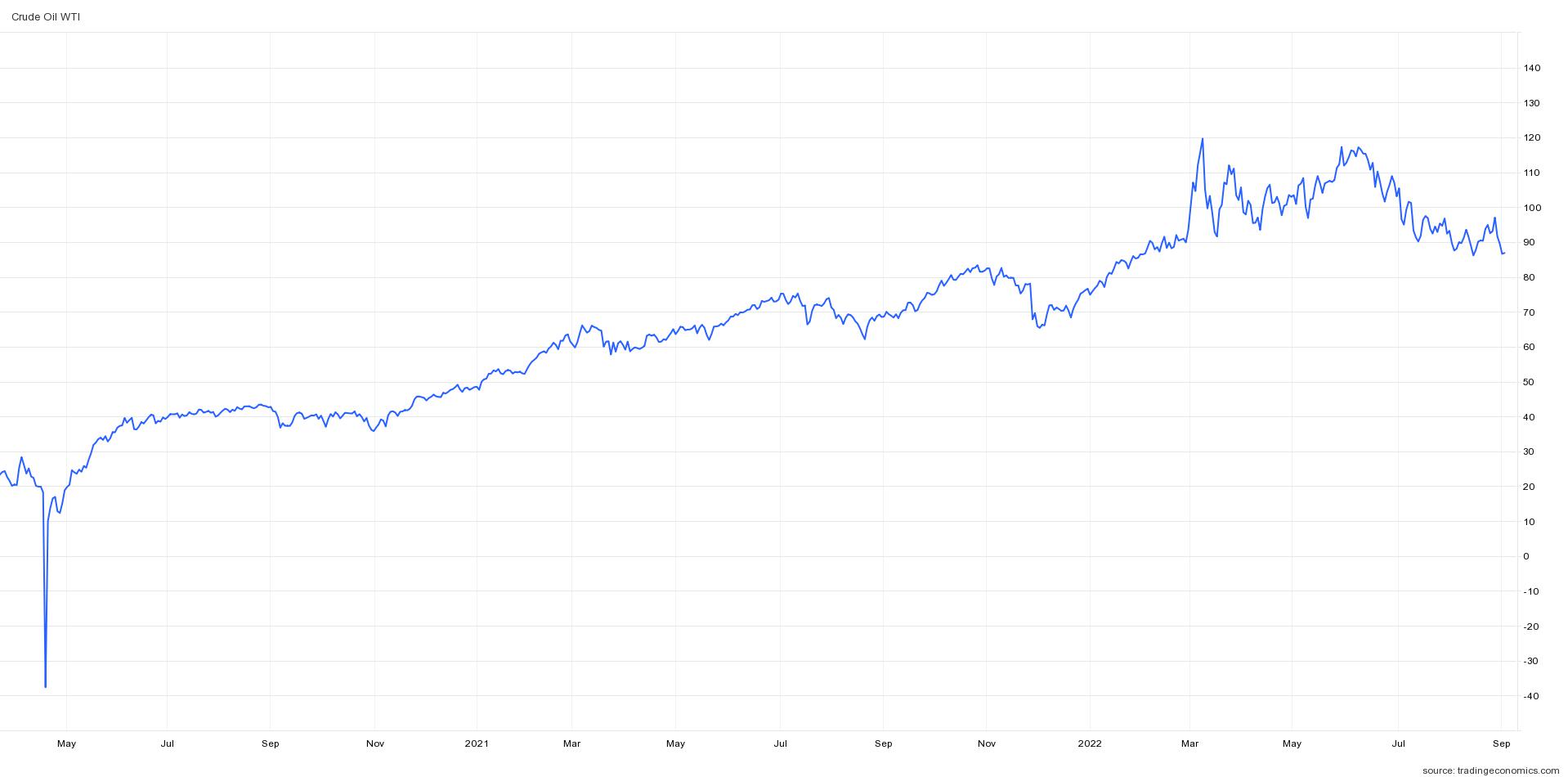
2020年4月21日,受2020年石油价格战影响,美国5月WTI原油期货收盘暴跌306%,首次降为负值。
WTI Crude Oil
2022年9月3日的价格是USD87
大马KLSE在2022年年头还有1600点。5月5日的收市是1582点。 然后就是一路跌,跌到1400点。
现在的收益,比起5月5日时,差好多。
当时,大家都以为国门开放,市场恢复。但是,俄罗斯和乌克兰的战争,美联储连续在6月15日和7月27日,各加息0.75%。直接把马股打趴到地。
GE15还不来。国内政治一片乱象。 大选不来,国行就没有采取积极的加息行动。然后,马币贬值。
我手上还是有些股票。需要亏钱脱手。把握现金。
当市场狂热,股票涨,赚钱时,就要准备离开。 当时,贪心。想多赚。其实,应该拿回本钱。
结果,9月头才要离场,赚的都变成不赚,还要去亏那些本来就亏的。
保本第一。这次又是个教训。
我看Youtube台湾杨世光金钱爆的影片。 他特低提醒观众仔细去读美联储主席鲍威尔(Jerome Powell)的演说。
鲍威尔8月26日,8分钟的的演说后,美国三大指数应声狂泻。道琼斯工业平均指数下跌超过1,000点;纳斯达克综合指数下跌近500点;标准普尔500指数下跌了140多点。
所有这三个指数的跌幅都超过了3%,但仍均略高于一个月前的水平。在近一段时间里的上涨幅度,大部分都在周五被抹去。
August 26, 2022
Chair Jerome H. Powell
At “Reassessing Constraints on the Economy and Policy,” an economic policy symposium sponsored by the Federal Reserve Bank of Kansas City, Jackson Hole, Wyoming
Thank you for the opportunity to speak here today.
At past Jackson Hole conferences, I have discussed broad topics such as the ever-changing structure of the economy and the challenges of conducting monetary policy under high uncertainty. Today, my remarks will be shorter, my focus narrower, and my message more direct.
The Federal Open Market Committee's (FOMC) overarching focus right now is to bring inflation back down to our 2 percent goal. Price stability is the responsibility of the Federal Reserve and serves as the bedrock of our economy. Without price stability, the economy does not work for anyone. In particular, without price stability, we will not achieve a sustained period of strong labor market conditions that benefit all. The burdens of high inflation fall heaviest on those who are least able to bear them.
Restoring price stability will take some time and requires using our tools forcefully to bring demand and supply into better balance. Reducing inflation is likely to require a sustained period of below-trend growth. Moreover, there will very likely be some softening of labor market conditions. While higher interest rates, slower growth, and softer labor market conditions will bring down inflation, they will also bring some pain to households and businesses. These are the unfortunate costs of reducing inflation. But a failure to restore price stability would mean far greater pain.
The U.S. economy is clearly slowing from the historically high growth rates of 2021, which reflected the reopening of the economy following the pandemic recession. While the latest economic data have been mixed, in my view our economy continues to show strong underlying momentum. The labor market is particularly strong, but it is clearly out of balance, with demand for workers substantially exceeding the supply of available workers. Inflation is running well above 2 percent, and high inflation has continued to spread through the economy. While the lower inflation readings for July are welcome, a single month's improvement falls far short of what the Committee will need to see before we are confident that inflation is moving down.
We are moving our policy stance purposefully to a level that will be sufficiently restrictive to return inflation to 2 percent. At our most recent meeting in July, the FOMC raised the target range for the federal funds rate to 2.25 to 2.5 percent, which is in the Summary of Economic Projection's (SEP) range of estimates of where the federal funds rate is projected to settle in the longer run. In current circumstances, with inflation running far above 2 percent and the labor market extremely tight, estimates of longer-run neutral are not a place to stop or pause.
July's increase in the target range was the second 75 basis point increase in as many meetings, and I said then that another unusually large increase could be appropriate at our next meeting. We are now about halfway through the intermeeting period. Our decision at the September meeting will depend on the totality of the incoming data and the evolving outlook. At some point, as the stance of monetary policy tightens further, it likely will become appropriate to slow the pace of increases.
Restoring price stability will likely require maintaining a restrictive policy stance for some time. The historical record cautions strongly against prematurely loosening policy. Committee participants' most recent individual projections from the June SEP showed the median federal funds rate running slightly below 4 percent through the end of 2023. Participants will update their projections at the September meeting.
Our monetary policy deliberations and decisions build on what we have learned about inflation dynamics both from the high and volatile inflation of the 1970s and 1980s, and from the low and stable inflation of the past quarter-century. In particular, we are drawing on three important lessons.
The first lesson is that central banks can and should take responsibility for delivering low and stable inflation. It may seem strange now that central bankers and others once needed convincing on these two fronts, but as former Chairman Ben Bernanke has shown, both propositions were widely questioned during the Great Inflation period.1 Today, we regard these questions as settled. Our responsibility to deliver price stability is unconditional. It is true that the current high inflation is a global phenomenon, and that many economies around the world face inflation as high or higher than seen here in the United States. It is also true, in my view, that the current high inflation in the United States is the product of strong demand and constrained supply, and that the Fed's tools work principally on aggregate demand. None of this diminishes the Federal Reserve's responsibility to carry out our assigned task of achieving price stability. There is clearly a job to do in moderating demand to better align with supply. We are committed to doing that job.
The second lesson is that the public's expectations about future inflation can play an important role in setting the path of inflation over time. Today, by many measures, longer-term inflation expectations appear to remain well anchored. That is broadly true of surveys of households, businesses, and forecasters, and of market-based measures as well. But that is not grounds for complacency, with inflation having run well above our goal for some time.
If the public expects that inflation will remain low and stable over time, then, absent major shocks, it likely will. Unfortunately, the same is true of expectations of high and volatile inflation. During the 1970s, as inflation climbed, the anticipation of high inflation became entrenched in the economic decisionmaking of households and businesses. The more inflation rose, the more people came to expect it to remain high, and they built that belief into wage and pricing decisions. As former Chairman Paul Volcker put it at the height of the Great Inflation in 1979, "Inflation feeds in part on itself, so part of the job of returning to a more stable and more productive economy must be to break the grip of inflationary expectations."2
One useful insight into how actual inflation may affect expectations about its future path is based in the concept of "rational inattention."3 When inflation is persistently high, households and businesses must pay close attention and incorporate inflation into their economic decisions. When inflation is low and stable, they are freer to focus their attention elsewhere. Former Chairman Alan Greenspan put it this way: "For all practical purposes, price stability means that expected changes in the average price level are small enough and gradual enough that they do not materially enter business and household financial decisions."4
Of course, inflation has just about everyone's attention right now, which highlights a particular risk today: The longer the current bout of high inflation continues, the greater the chance that expectations of higher inflation will become entrenched.
That brings me to the third lesson, which is that we must keep at it until the job is done. History shows that the employment costs of bringing down inflation are likely to increase with delay, as high inflation becomes more entrenched in wage and price setting. The successful Volcker disinflation in the early 1980s followed multiple failed attempts to lower inflation over the previous 15 years. A lengthy period of very restrictive monetary policy was ultimately needed to stem the high inflation and start the process of getting inflation down to the low and stable levels that were the norm until the spring of last year. Our aim is to avoid that outcome by acting with resolve now.
These lessons are guiding us as we use our tools to bring inflation down. We are taking forceful and rapid steps to moderate demand so that it comes into better alignment with supply, and to keep inflation expectations anchored. We will keep at it until we are confident the job is done.
我在8月13日,Harta跌破RM2时,就入场买一些Harta股票。
8月15日,Harta就跌倒RM1.85.真打脸。
接下来,还有2个会照成手套股继续跌跌的情况。
1)Topglove9月份的财报出现亏损。
2)Harta在下个半年检讨跌出综指成分股。
我会买Harta和Kossan.
以下文章转发自星洲日报
(吉隆坡15日讯)贺特佳(HARTA,5168,主板医疗保健组)公布逊色业绩后引爆的手套股大抛风至今仍然没完没了,今日卖压更为严重,导致“四大天王”兵败如山倒。
10大热门股就有3只是手套股,显示卖压不断升温。其中顶级手套(TOPGLOV,7113,主板医疗保健组)虽然开盘微扬0.5仙至86仙,以高姿态掀开交易,随后卖压涌现,最低曾降至77仙,猛挫8.5仙或9.94%,写下两月来最大单日跌幅,闭市挂79.5仙,仍大跌6仙或7.02%,连跌第四天,全天成交量增至1亿7887万2900股,为全场最热门股。
高产柅品(KOSSAN,7153,主板医疗保健组)连跌第六天,失守1令吉关口,最低跌10仙或9.35%至97仙,收盘报98.5仙,共跌8.5仙或7.94%,成交量5849万零500股,为第六热门股。
贺特佳跌破2令吉,最低跌15仙或7.50%至1令吉85仙,闭市报1令吉86仙,全天跌14仙或7%,成交量扩大至5057万4400股,为第四下跌股和第七热门股。
速柏玛(SUPERMX,7106,主板医疗保健组)最低报75仙,共跌3.5仙或4.46%,闭时报75.5仙,全日跌3仙或3.82%,成交量共1325万6900股。
其他小型手套股也全盘皆墨,其中加护手套(CAREPLS,0163,创业板医疗保健组)跌2仙至35.5仙、康复手套(COMFORT,2127,主板工业产品服务组)跌0.5仙至48仙、稳大(ADVENTA,7191,主板医疗保健组)跌1.5仙至60.5仙,以及来百利机构(RUBEREX,7803,主板工业产品服务组)跌1仙至46.5仙。
贺特佳最新业绩逊色,引爆这一轮手套股大抛风,当中又以雇员公积金局(EPF)最踊跃,由于这家“马股大股东”不断抛售贺特佳,打击了投资者的信心,导致手套股的卖压不断,在马股大盘回稳之际,这些在2020年领尽风骚的类股却独憔悴。
交易所最新数据显示,公积金局上周三(10日)再卖出贺特佳的509万2000股后,持股已降至2亿2852万4389股或6.67%,低于去年12月31日的2亿7396万9989股或7.99%。
至于顶级手套,公积金局更是早在5月23日脱售978万2300股后,持股就已降至5%以下或3亿9709万4266股,不再是这家全球最大手套制造公司的主要股东,也无需再呈报其持股变化。去年12月31日,公积金局掌握顶级手套的5亿零220万9766股或6.27%。
贺特佳是在8月9日公布,截至2022年6月30日首季净利重挫96%至8820万令吉,因为面对胶手套平均售价正常化,以及销售需求下滑的双重打击。分析员警告,贺特佳股价如果进一步下跌,可能在下个半年检讨跌出综指成分股,令该股进一步受到重创。
2022年8月15日闭市价

Reading the company announcement at Bursa website and notice that Chin Hin share price increased within a short time due to issuance of bonus share.
15th July 2022 closed at RM3.14
4th July 2022 closed at RM5.37


